Before we begin the story of Prophet Muhammad ﷺ, we must first understand the world into which he was born.
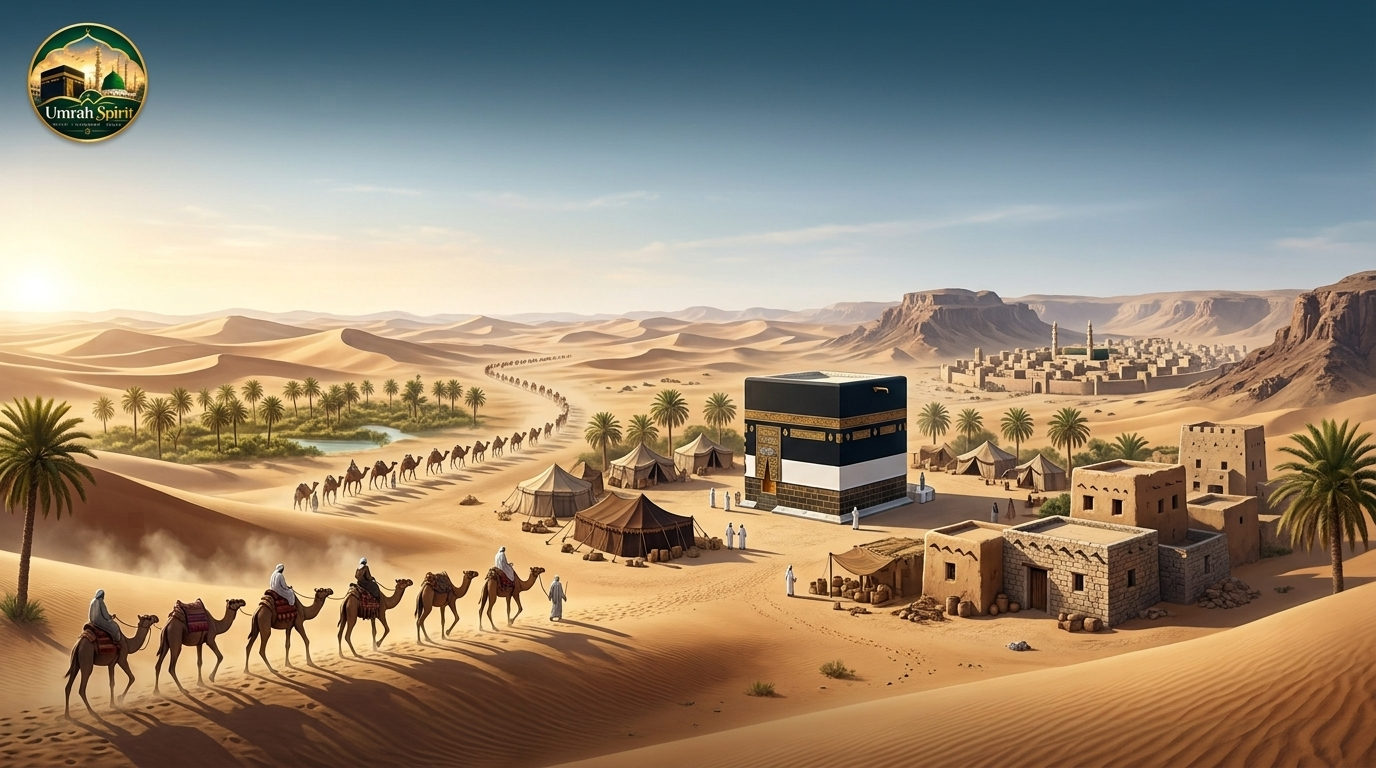
More than 1,400 years ago, the Arabian Peninsula was a land of vast deserts, mountains, valleys, trading routes, tribal communities, and ancient settlements. Arabia was not a single unified kingdom. Its people lived in different ways: some were settled in towns and oases, while others lived a nomadic life, moving with their animals in search of water and pasture.
By the sixth century, Arabia was also connected to the wider world through trade and political relationships with the Byzantine and Sasanian empires, as well as regions such as Yemen, Syria, Iraq, and East Africa.
But among all the cities of Arabia, one city would become central to the greatest transformation in human history:
Makkah.
1. Makkah — The Sacred City
Makkah was located in a rugged valley in the western Arabian Peninsula. It did not possess the agricultural advantages of many other settlements, yet its religious importance and position on regional trade routes helped make it an important center.
The Ka'bah stood at the heart of Makkah.
The Qur'an describes the House at Bakkah as a blessed sanctuary and a source of guidance for humanity:
“Surely the first House ˹of worship˺ established for humanity is the one at Bakkah—a blessed sanctuary and a guide for ˹all˺ people.”
— Qur'an 3:96
According to the Qur'an, Prophet Ibrahim (Abraham) عليه السلام also prayed for the security of this city and asked Allah to protect himself and his descendants from idol worship.
The Qur'an further describes Ibrahim عليه السلام settling some of his descendants in an uncultivated valley near the Sacred House so that they could establish prayer.
Thus, Makkah had a sacred history long before the birth of Muhammad ﷺ.
2. The Ka'bah and Pilgrimage
The Ka'bah was not merely a building in Makkah. It was connected to the legacy of Ibrahim and Isma'il عليهما السلام.
The Qur'an tells us that Allah commanded Ibrahim and Isma'il عليهما السلام to purify His House for those who would perform tawaf, remain there in worship, and bow and prostrate.
Over the centuries, however, the original monotheistic worship associated with the House became mixed with practices of idol worship.
By the time immediately before Islam, Makkah remained an important pilgrimage destination, but the religious practices surrounding the sanctuary had changed significantly. Historical sources describe the Ka'bah as a sanctuary visited by Arabs from different parts of the peninsula.
This contrast is important:
The sacred House remained, but the religious beliefs and practices surrounding it had become deeply corrupted.
3. Tribal Society
Pre-Islamic Arabian society was strongly influenced by tribal identity.
A person's tribe provided protection, social identity, alliances, and a sense of belonging. Loyalty to one's clan could be extremely powerful.
There was no single central government controlling the entire Arabian Peninsula. Instead, tribes and local rulers governed different regions, while alliances and rivalries constantly changed.
This tribal structure produced both strengths and serious problems.
Among the strengths were:
- Courage and bravery
- Generosity toward guests
- Loyalty to one's tribe
- Strong protection of family and allies
- Respect for poetry and eloquence
- Hospitality toward travelers
At the same time, tribal loyalty could also contribute to prolonged conflicts, revenge, and cycles of warfare.
In a society where protection often depended upon one's tribe, the weak and socially unprotected could be especially vulnerable.
4. Religion in Arabia
Religion in Arabia before Islam was not completely uniform.
Polytheistic practices were widespread, particularly among many communities in western Arabia. At the same time, Judaism and Christianity were present in different parts of the peninsula, and Zoroastrian influence could also be found in areas connected to the Persian world.
In Makkah, idol worship had become deeply established.
The Qur'an repeatedly challenges the worship of idols and calls people back to the worship of Allah alone.
The Qur'an also preserves the prayer of Ibrahim عليه السلام:
“My Lord, make this city ˹of Mecca˺ secure, and keep me and my children away from the worship of idols.”
— Qur'an 14:35
This verse gives us an important perspective: the message of Islam would not introduce the worship of one God as something completely unrelated to Arabia's sacred history. Rather, it would call people back to the pure monotheism associated with Ibrahim عليه السلام.
5. Moral Problems and Social Injustice
The pre-Islamic period is often referred to in Islamic sources as the period of Jahiliyyah.
This does not mean that every person in Arabia was evil or that every aspect of their society was without virtue.
Rather, the Qur'anic concept of Jahiliyyah points to a condition of religious ignorance and moral practices that contradicted divine guidance.
Some people were generous, brave, trustworthy, and honorable. But serious social problems also existed.
Among the practices condemned by the Qur'an was the killing of infant girls.
Allah says:
“And when the girl who was buried alive is asked for what sin she was killed.”
— Qur'an 81:8–9
There were also problems involving tribal revenge, exploitation, injustice toward the vulnerable, and social inequality.
Islam would later challenge these practices and establish principles of justice, accountability, mercy, charity, and human dignity.
6. Makkah as a Place of Trade
Makkah's importance was not purely religious.
Its location connected it to regional trade networks. Merchants traveled between Arabia and surrounding regions, and Quraysh became an influential tribe in Makkah.
The Qur'an itself refers to the Quraysh's journeys:
“For the accustomed security of the Quraysh—
their accustomed security in the journeys of winter and summer...”
— Qur'an 106:1–2
Historical accounts also describe Makkah as both a commercial center and a sacred place where religious observances helped create conditions for trade and pilgrimage.
This combination of religion, pilgrimage, tribal authority, and commerce made Makkah a particularly important city in western Arabia.
7. The Quraysh
The tribe of Quraysh held a central position in Makkah.
Different clans of Quraysh shared influence over the city and its affairs. Among them was Banu Hashim, the clan into which Muhammad ﷺ would eventually be born.
The Quraysh were involved in trade and had established relationships with communities and regions beyond Makkah.
This meant that the young Muhammad ﷺ would grow up in a society that was not isolated from the outside world. He would encounter merchants, travelers, tribal leaders, and people from different backgrounds.
8. A World Waiting for Change
So, what was Arabia like before Muhammad ﷺ?
It was a world of contradictions.
There was courage, but also injustice.
There was generosity, but also oppression.
There was eloquence and poetry, but widespread religious confusion.
There was a sacred House established for the worship of Allah, but idols had become associated with its worship.
There were strong tribal bonds, but those same bonds could fuel division and revenge.
And into this world, Allah would send His final Messenger.
The Qur'an describes Muhammad ﷺ as a mercy to the worlds:
“And We have not sent you except as a mercy to the worlds.”
— Qur'an 21:107
The story of Muhammad ﷺ did not begin in a world without history.
It began in Makkah—a city whose sacred history reached back to Ibrahim and Isma'il عليهما السلام, a city of pilgrimage and trade, and a society desperately in need of divine guidance.
And soon, a child would be born there whose life would change the course of history forever.
That child was Muhammad ibn Abdullah ﷺ.
To Be Continued...
Part 2: The Noble Lineage of Prophet Muhammad ﷺ
In the next part, we will explore the lineage of the Prophet ﷺ, his family, Banu Hashim, his father Abdullah, and the circumstances surrounding his birth.